


Sometimes you didn’t boot up a computer to relax. You booted it up to survive. Before achievements, before save points, before mercy, there was The Oregon Trail. And if you’re a millennial, there’s a very good chance this game lives in your brain forever.
Why Every Millennial Knows The Oregon Trail
The Oregon Trail wasn’t just a game you played at school. It was the game. Computer lab day meant green text, chunky pixels, and the quiet tension of hoping nobody in your wagon party died before lunchtime.
At its core, The Oregon Trail is an educational strategy game that puts you in charge of a family traveling west in 1848. You start in Independence, Missouri, aiming for the Willamette Valley in Oregon. Sounds simple. It never was.
You had to think ahead, ration supplies, decide when to rest, when to push forward, and when to risk crossing a river that absolutely did not care about your plans.
Learning Without Feeling Like Homework
What made The Oregon Trail stick was how sneaky it was. You were learning history, geography, and problem-solving without realizing it. Every decision mattered. Too much food and you ran out of money. Too little food and… well, you know how that goes.
The game forced you to think in cause and effect. Bad planning showed consequences fast. Sometimes unfair ones. That lesson hit hard for a lot of kids and made the experience feel serious in a way most school games never did.
The Stress Was Real in The Oregon Trail

Crossing rivers. Hunting for food. Watching supplies dwindle. Random illnesses showing up out of nowhere. The Oregon Trail didn’t soften anything. You learned pretty quickly that optimism wasn’t enough.
That tension is why people still talk about it. It wasn’t flashy, but it made you feel responsible. Every loss felt personal, especially when the game calmly informed you that someone had passed away and then kept moving forward like nothing happened.
A Long History in Classrooms
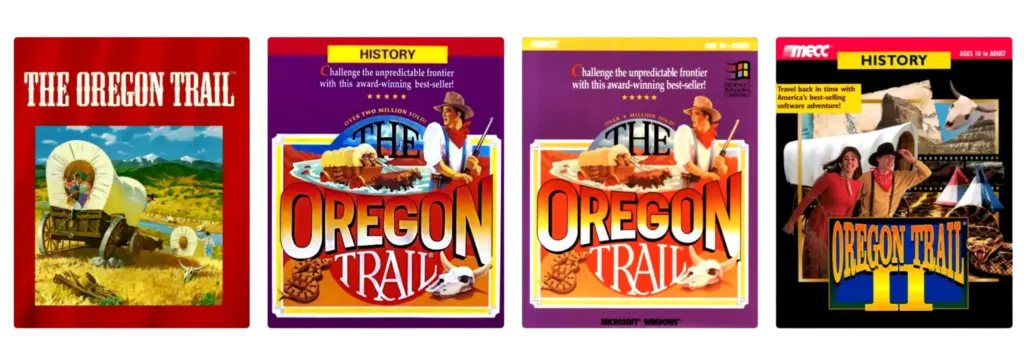
The Oregon Trail started as a text-based game in 1971, created to teach students about westward expansion. It was later published by the Minnesota Educational Computing Consortium in 1975, before getting its iconic graphical version in 1985 on the Apple II.
That version is the one most millennials remember. The pixel art. The menus. The hunting segments where you’d frantically shoot animals while hoping your teacher wasn’t watching too closely.

Why The Oregon Trail Still Gets Mentioned
The Oregon Trail didn’t just teach facts. It taught planning, patience, and acceptance that sometimes things go wrong no matter how careful you are. That mix of learning and low-key dread burned itself into a generation.

It’s remembered not because it was kind, but because it was honest. You made choices, and the game followed through. No take-backs.
Why The Oregon Trail Was So Iconic, Fun, and Still Works Today
Part of what made The Oregon Trail stick wasn’t just the challenge, it was the way the game quietly knew how absurd it all was. You could be doing everything right, feeling confident, and then the game would throw a completely random setback your way with a straight face. That contrast made it funny without ever needing jokes.
The hunting segments felt like a mini arcade game dropped into history class. The sudden pop-ups telling you someone got sick were blunt in a way that almost felt sarcastic. It never talked down to players or tried to soften the experience, and that honesty made it oddly enjoyable.
Even today, The Oregon Trail still works because it doesn’t try to be trendy or overexplain itself. It trusts players to learn by doing, failing, and trying again. That mix of seriousness and quiet humor is why people still reference it, remix it, and smile the second its name comes up.
“You have died of dysentery.”
Yeah. Every millennial knows exactly how that line felt. For more nostalgic posts be sure to visit our 90s & Y2K section!
Want to work with us?

Geek out with us!
- Newsletter
- Patreon
- Socials
- I Married a Monster on a Hill (Award-Winning Series)